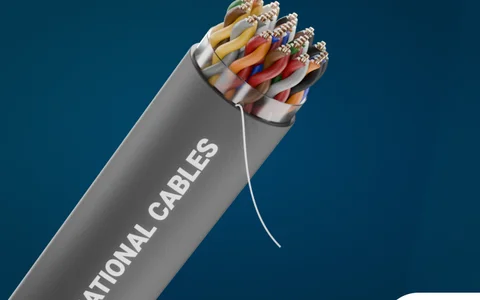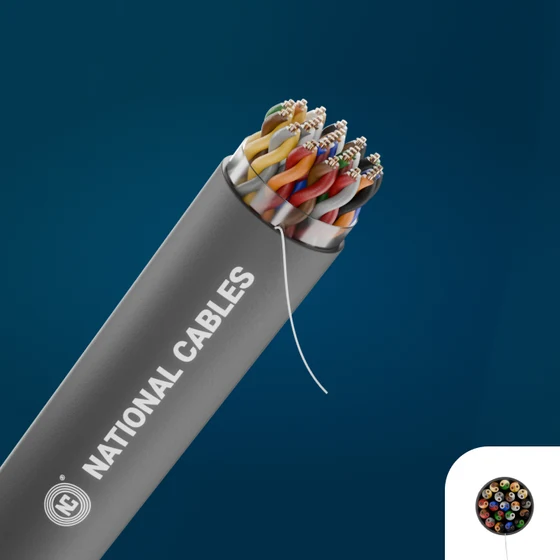
CW1308 Internal Telephone Cable
Solid 0.5mm bare annealed copper pairs with precision twist lay and colour-coded PVC insulation — built for voice and low-speed signalling on PABX risers, hotel telephone drops, intercom runs, and institutional distribution. Manufactured to BT Specification CW1308 as a made-to-order project cable.
CW1308 — Typical construction and electrical parameters
Indoor telephone distribution for PABX, administrative blocks, and voice backbones. Electrical parameters are per BT Specification CW1308. Factory test certificates issued per drum serial on request.
| Pair Count | Conductor | Sheath | Conductor R max (Ω/km) | Insulation R min (MΩ·km) | Cap. unbalance (pF/km) | Typical application |
|---|---|---|---|---|---|---|
| Standard Stock Range — 0.5mm Solid Bare Annealed Copper | ||||||
| 2 Pair | 0.5mm | PVC White | Max 97.8 | Min 50 | Max 500 | Domestic extension, door entry |
| 4 Pair | 0.5mm | PVC White | Max 97.8 | Min 50 | Max 500 | Hotel room drops, small office |
| 6 Pair | 0.5mm | PVC White | Max 97.8 | Min 50 | Max 500 | PABX horizontal distribution |
| 10 Pair | 0.5mm | PVC White | Max 97.8 | Min 50 | Max 500 | Floor riser, MDF sub-distribution |
| 20 Pair | 0.5mm | PVC White | Max 97.8 | Min 50 | Max 500 | PABX backbone, institutional riser |
| Extended Range — Made to Order | ||||||
| 25–100 Pair | 0.5mm | PVC White | Max 97.8 | Min 50 | Max 500 | Multi-pair backbone trunks; 50P+ includes optional 1.38mm earth |
| 2–20 Pair | 0.5mm | LSZH White | Max 97.8 | Min 50 | Max 500 | Hospitals, public buildings, high-risk fire environments |
| All values per BT Specification CW1308. Conductor resistance max 97.8 Ω/km at 20°C for 0.5mm. Confirm specification on factory test certificate per drum serial number. | ||||||
| Parameter | Limit / value | Notes |
|---|---|---|
| Conductor material | Solid bare annealed copper — 0.5mm standard | IEC 60228 Class 1 (solid) |
| Conductor resistance @ 20°C | Max 97.8 Ω/km | Per BT Specification CW1308 |
| Insulation resistance @ 20°C | Min 50 MΩ·km | Per BT Specification CW1308 |
| Capacitance unbalance | Max 500 pF/km | Per BT Specification CW1308 |
| Operating temperature | 0°C to +70°C | Fixed indoor installation |
| Sheath colour | White PVC (standard) · LSZH white (variant) | Black available on some pair counts |
CW1308 variants — which to specify?
BT Specification CW1308 covers internal telephone cable. Three principal variants serve different installation environments — all use the same 0.5mm solid copper conductor and twisted-pair construction.
Cable construction — four layers.
CW1308-style internal telephone cable uses a layered construction optimised for voice-frequency transmission and reliable seating in MDF/IDC hardware.
Key characteristics for voice-frequency distribution.
Applications.
Standards this product is manufactured to.
CW1308 internal telephone cable is manufactured to BT Specification CW1308 as a made-to-order project item. Manufacturing operations are certified to ISO 9001:2015.
CW1308 telecommunication cable — technical questions answered.
Common questions from telecom contractors, security installers, IT infrastructure teams, and building services engineers specifying BT CW1308 internal telephone cable.
Can CW1308 be used for outdoor telephone installations?
No. Standard CW1308 is an internal BT-specification telephone cable with a PVC sheath that is not UV-stabilised or weather-resistant. For outdoor installations, specify CW1128 (polyethylene sheathed, jelly-filled for moisture resistance) or CW1308B (external-grade variant with UV-resistant sheath).
Using internal CW1308 outdoors will result in premature sheath cracking from UV exposure and moisture ingress into the pairs. National Cables manufactures CW1308 internal telephone cable to BT specification — for external telecom cable requirements, please consult our technical team.
What is the standard conductor diameter for CW1308?
Standard CW1308 uses 0.5mm solid bare annealed copper conductors (IEC 60228 Class 1). Additional diameters — 0.4mm, 0.6mm, 0.9mm — are available for specific pair counts on order.
Pair counts range from 2 pairs to 100 pairs, with larger multi-pair configurations (50 pairs and above) including an optional separate 1.38mm plain copper earth core. Confirm exact pair count, sheath material (PVC or LSZH), and earth conductor requirement at order specification.
How are pairs identified in CW1308 cable?
CW1308 pairs follow the British Telecom colour code. Typical pair identification:
Pair 1 — White/Blue + Blue/White
Pair 2 — White/Orange + Orange/White
Pair 3 — White/Green + Green/White
Pair 4 — White/Brown + Brown/White
Pair 5 — White/Grey + Grey/White
Higher pair counts continue the sequence with additional base/tracer colour combinations per the BT standard. For exact colour coding on larger pair counts or specific project requirements, refer to the product datasheet.
Does this cable comply with British Telecom specifications?
Yes. Our CW1308 internal telephone cable is manufactured to British Telecom specification CW1308, covering conductor material (0.5mm solid bare annealed copper, IEC 60228 Class 1), pair construction, PVC insulation and sheathing, colour coding, and electrical performance.
The "CW1308" designation itself is BT's own document reference. Verify the CW1308 marking on the cable print legend and request the product datasheet for specific pair count and sheath variant (PVC or LSZH) confirmation.
Is CW1308 suitable for low-voltage alarm systems?
CW1308 can be used for low-voltage signal wiring in intruder alarm systems where a multi-pair solid-copper signal cable is acceptable, typically for internal alarm loops and door-entry systems.
However, for alarm systems that must comply with specific insurance, EN 50131, or fire-detection requirements (BS 5839, BS 4737 categorised cables), dedicated alarm or fire-resistant cable may be mandatory. Always confirm cable requirements with the alarm system manufacturer's installation guide and your insurance/regulatory authority before specification.
Request project pricing.
PABX fit-outs, hotel telephone projects, and government EPABX supply. Tell us your pair count, approximate quantities, and project timeline.
Related Telecom Cables.
View All Products →