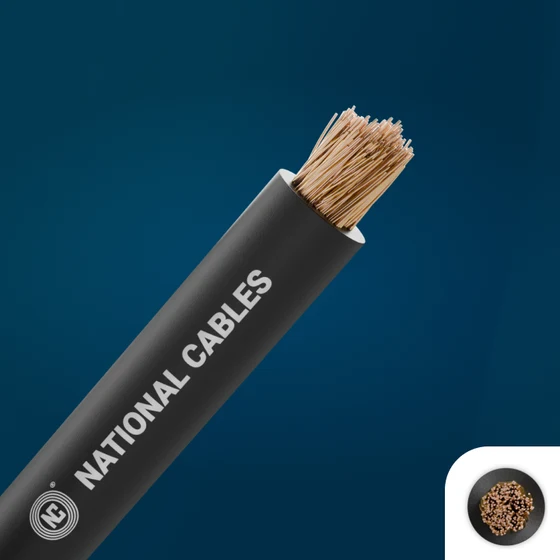
Single Core Flexible Wire (Class 5)
Single core flexible wire is the correct specification for panel internal wiring, OEM equipment harnessing, and any installation where the cable must be routed through tight bends, pulled through conduit repeatedly, or subjected to movement during installation. Class 5 fine stranding prevents the conductor work-hardening and fracturing that would occur with solid or lightly stranded wire under the same conditions.
Dimensional & Electrical Data — IS 694:2010
Single core flexible wire is priced and supplied per 100m drum. The table below shows the standard range with current ratings applicable to flexible installation conditions. Class 5 conductor resistance values per IS 8130:2013.
| Cross Section (mm²) | Nominal Insulation Thickness (mm) | Approx. OD (mm) | Current — In Conduit 2-cable 1φ (A) | Current — In Conduit 3-cable 3φ (A) | Current — Clipped Direct 1φ (A) | Current — Clipped Direct 3φ (A) | Current — Clipped Direct 1φ, BS 7671 Basis (A) | Max DC Resistance at 20°C (Ω/km) |
|---|---|---|---|---|---|---|---|---|
| Industrial & Panel Wiring Range (Standard Stock) | ||||||||
| 0.5 | 0.6 | 2.25 | 4 | — | 5 | — | — | 39.0 |
| 0.75 | 0.6 | 2.40 | 7 | — | 8 | — | — | 26.0 |
| 1.0 | 0.6 | 2.60 | 11 | 9 | 12 | 12 | 15 | 19.5 |
| 1.5 | 0.7 | 2.90 | 13 | 11 | 16 | 15 | 20 | 13.3 |
| 2.5 | 0.8 | 3.90 | 18 | 16 | 22 | 20 | 27 | 7.98 |
| 4.0 | 0.8 | 4.50 | 24 | 20 | 29 | 26 | 37 | 4.95 |
| 6.0 | 0.8 | 5.30 | 31 | 25 | 37 | 33 | 47 | 3.30 |
| Heavy Industrial Range (Project Drums) | ||||||||
| 10.0 | 1.0 | 6.70 | 42 | 35 | 51 | 45 | 65 | 1.91 |
| 16.0 | 1.0 | 8.2 | 57 | 48 | 68 | 61 | 87 | 1.21 |
| 25.0 | 1.2 | 10.0 | 71 | 60 | 86 | 78 | 114 | 0.780 |
| 35.0 | 1.2 | 11.3 | 91 | 77 | 110 | 99 | 141 | 0.554 |
| 50.0 | 1.4 | 13.5 | 120 | 100 | 145 | 135 | 182 | 0.386 |
| 70.0 | 1.4 | 15.5 | 165 | 145 | 200 | 180 | 234 | 0.272 |
| 95.0 | 1.6 | 18.2 | 200 | 165 | 235 | 215 | 284 | 0.206 |
| 120.0 | 1.6 | 20.2 | 225 | 195 | 270 | 240 | 330 | 0.161 |
| 150.0 | 1.8 | 22.5 | — | — | 310 | 280 | 381 | 0.129 |
| 185.0 | 2.0 | 24.6 | — | — | 360 | 320 | 436 | 0.106 |
| 240.0 | 2.2 | 27.6 | — | — | 425 | 385 | 515 | 0.0801 |
| Technical Notes: OD values are approximate, within IS 694:2010 dimensional limits. Stock-range conduit/clipped ratings per IS 3961 (Part 5):1968 Table 1 (40°C basis); extended range (120–240mm²) per Table 2 — close excess-current protection (MCB) basis, conduit values above 120mm² not specified; BS 7671 column per Table 4D1A Method C (30°C). Standard packaging: 100m spools; 500m/1000m drums available for automated assembly. Use our size calculator for de-rating guidance → | ||||||||
Correct current ratings for your installation temperature.
All current ratings in the table above are tabulated at 30°C ambient. Apply de-rating factors for installations where ambient temperature exceeds this reference.
| Ambient Temp | Multiply by |
|---|---|
| 25°C | 1.03 |
| 30°C | 1.0 |
| 35°C | 0.94 |
| 40°C | 0.87 |
| 45°C | 0.79 |
| 50°C | 0.71 |
| 55°C | 0.61 |
| 60°C | 0.5 |
| Reference: 30°C ambient. Source: BS 7671:2018+A2:2022 Table 4B1 (70°C thermoplastic) | |
Example: 10mm² wire clipped direct = 51A at 30°C. At 45°C ambient: 51 × 0.79 = 40A.
This is particularly relevant for installations in industrial buildings, rooftop runs, and locations where summer ambient temperatures regularly exceed 40°C.
Fully vertically integrated manufacturing.
Single core flexible wire shares the same copper drawing and annealing process as our fixed installation range — but with a critical difference at the stranding stage. Class 5 construction uses a higher strand count than Class 1 or 2, with finer individual wire diameters, to achieve flexibility without sacrificing conductivity.
Class 5 Flexible Panel Wire for Switchgear & OEM Harnessing
Each property below is the result of a specific manufacturing decision — Class 5 stranding, in-line annealing, tight dimensional tolerances. Verified on every production lot.
Where this wire is specified.
Single core flexible wire is specified wherever a cable must be routed through tight spaces, pulled through conduit, or terminated in compact connectors. It is the standard for internal panel wiring, OEM equipment, and industrial installations where repeated movement during installation would damage a solid or lightly-stranded conductor.
Standards this product is manufactured to.
National Cables Single Core Flexible Wire is manufactured to IS 694:2010 and tested per IS 8130:2013 for conductor class verification. Full documentation available for institutional procurement, government tenders, and export requirements.
Single core flexible wire — technical questions answered.
Common questions from electricians, panel builders, residential contractors, and industrial procurement teams specifying Class 5 flexible single core wire to IS 694:2010.
What is the difference between Class 2 rigid and Class 5 flexible conductor?
Per IS 8130:2013 / IEC 60228, Class 2 uses a small number of relatively thick copper strands, producing a stiffer stranded conductor suited to fixed installation in building wiring and conduit systems where the route is relatively straight.
Class 5 uses many fine copper strands, producing a highly flexible conductor ideal for panel wiring, control cabinet routing with multiple bends, and installations requiring manual cable manipulation during fit-out.
Both classes have equivalent electrical performance at the same cross-section — the choice depends on installation method and handling requirements.
Is Class 5 flexible wire suitable for house wiring?
Yes. Class 5 single-core flexible wire to IS 694:2010 is widely used for residential concealed-conduit wiring in India. The flexible copper conductor eases routing through conduits with multiple bends, reducing installation strain compared to rigid wire.
Select appropriate cross-section (1.0, 1.5, 2.5, or 4.0 mm²) based on circuit load and run length, verify the ISI mark and BIS licence number (National Cables holds CM/L-8800140116), and follow applicable wiring regulations.
For fire safety in multi-storey buildings, consider specifying FR-LSH or HFFR grade instead of standard FR.
What standard core colours are available for single core panel wire?
Standard IS 694:2010 core colour options include red, yellow, and blue (three-phase power designation), black (neutral), green or green/yellow (protective earth), and white (reference/control).
For panel wiring exported to European markets, colour coding follows IEC 60445 (brown, blue, green/yellow). Additional colours including grey are available for project quantities.
Contact our technical sales team for specific colour requirements and minimum order quantities for non-standard colours.
Why use flexible wire instead of solid core?
Flexible (Class 5) wire is preferred where installation requires routing through bends, tight terminations, or vibration-prone environments. The fine stranding absorbs mechanical stress better than solid conductors, simplifies termination in crowded control panels, and reduces the risk of micro-fractures in the copper during installation.
Solid wire (Class 1) is simpler to terminate in screw terminals and cost-effective for straight runs. Both deliver equivalent electrical performance at the same cross-section per IEC 60228.
Select based on installation topology and termination requirements.
Can Class 5 flexible wire be used with push-in terminals?
Sometimes, but always check the terminal manufacturer's specification. Push-in and spring-loaded terminals often accept solid conductors directly but require bootlace ferrules (crimped per DIN 46228) when used with fine-stranded Class 5 flexible wire.
Without a ferrule, fine strands may splay, cause unreliable contact, and risk thermal failure under load. For safe installation, follow the exact conductor class and ferrule requirement specified by the terminal manufacturer.
Request institutional pricing and technical documentation.
Our engineering team responds within 24 hours with accurate bulk pricing, complete compliance documentation, and specifications. BOQ uploads accepted.
Explore related industrial solutions.
View All Products →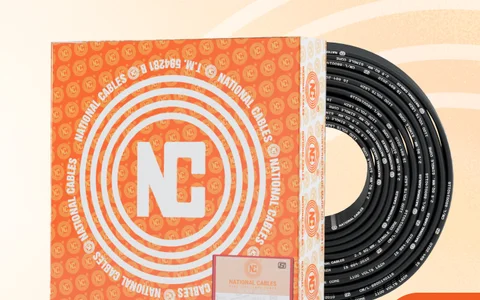
Supplying to an international project?
This flexible wire is manufactured to IS 694:2010 on a BIS-certified production line using Class 5 stranded copper. The same facility produces cable conforming to equivalent international standards — if your project specifies H07V-K / H05V-K / H05VV-F / H07VV-F, we can supply from the same certified manufacturing facility.